
Understanding the Project Management Triangle in Today’s Fast-Paced Environment
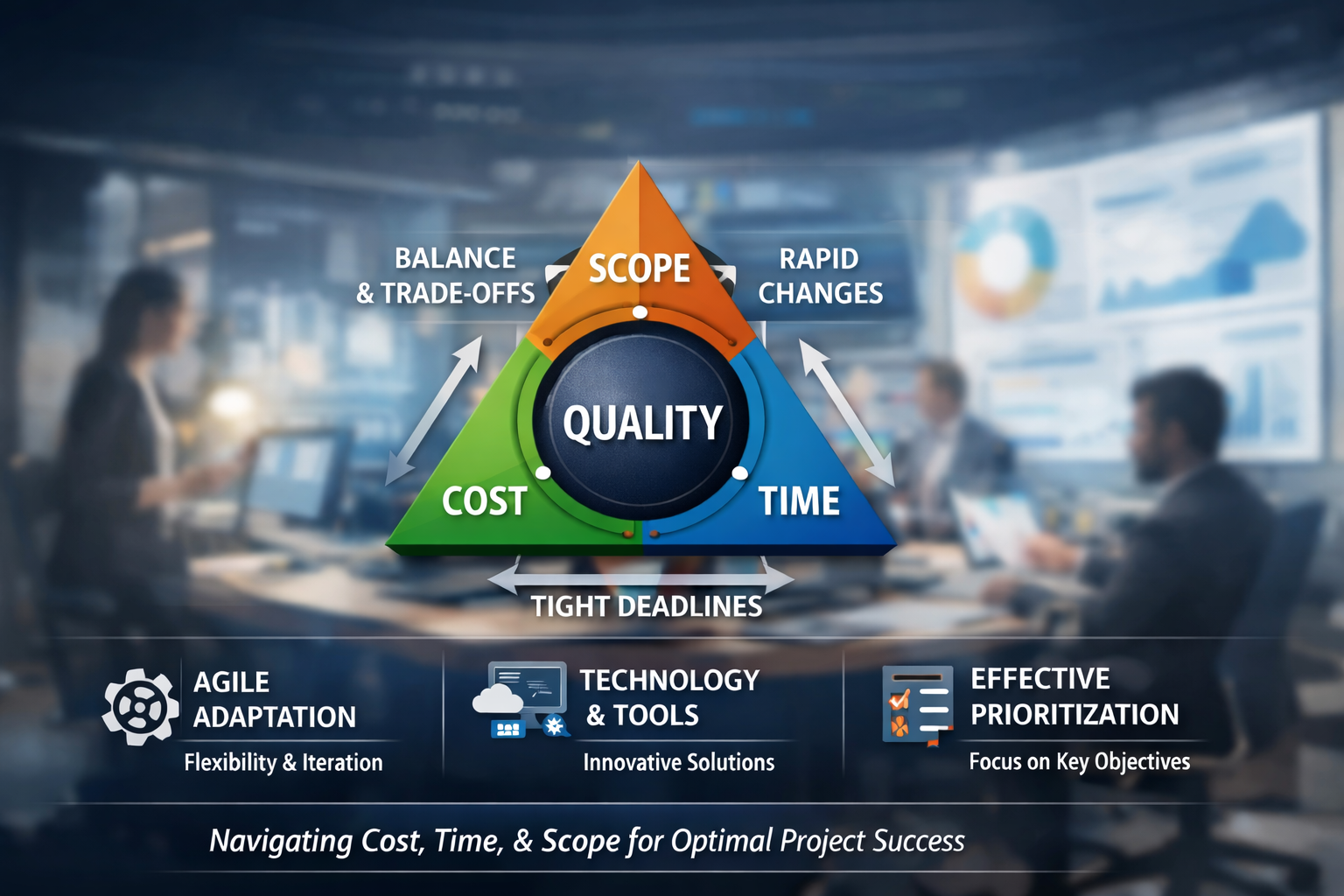
In this era of change that is driven by technology such as digital transformation and increased demand for project deliverables by customers, the job of project managers has never been tougher. They have to accelerate the speed of project execution while improving the quality of project results. Amidst all this challenge comes the essence of one important project management theory, the Project Management Triangle.
The classical representation of the triangle for project management is related to time, cost, and scope. The concept is simple: when one element in the triangle changes, another is necessarily affected. In the current fast paced business world, this triangle concept must be perceived not as rigid principles, but rather as an active decision aid.
The Traditional Project Management Triangle
Projects originally were planned in an environment that was usually steady. The requirements were fixed, time estimations could be predicted with a fair degree of accuracy, and changes could be kept at a minimum level. In this background:
- Time referred to the schedule for carrying out the project and meeting its time requirements.
- Cost referred to the budget for the overall project.
- scope defines the goals, tasks, deliverables, and project boundaries
The success of each project was realized by its capacity to complete the predefined scope within the approved budget and on time. “If any aspect of a project changed, such as when an accelerating deadline was imposed. This necessitated either incurring additional costs or further constraining scope.”
Although this paradigm proved successful in a controlled environment, present day projects face the challenge of a much greater level of uncertainty.
Why these triangles still matter..?
Despite advances in methodologies and technologies, the concept of the project management triangle is fundamental and essential. This makes managers and project stakeholders consider the realities of trade offs. In fast paced settings, there are expectations that are not realistic. More is expected of teams, faster, and cheaper.
The triangle is a reality check. It is useful in answering such questions as:
- What will it cost if we need a faster delivery?
- In cutting the budget, what should be altered in scope or quality?
- In cutting the budget, what should be altered in scope or quality?
How the Triangle Has Evolved
In contemporary project management, the project management triangle is no longer static. In other words, instead of fixed constraints, there is a need for continuous balancing in projects.
“Time” is no longer all about meeting deadlines. The ability to quickly get to market has now emerged as a competitive edge. Getting things early, through releases, and being flexible has become a preferred option over a rigid commitment to schedules.
Expenses are about staying within budget. However, “cost” actually refers to maximizing ROI. Investment decisions are made after considering “return,” “impact,” and “sustainability” rather than “cost savings” from a particular investment.
The “scope” of the work changed from what was rigid to what was flexible. Agile methodologies and the hybrid method promote the continuous development of scope based on customer feedback.
In the midst of this ever unfolding triangle, quality and value and ultimately what project success means today.
The Role of Quality and Value
In today’s fast paced world, quality cannot and should never be compromised for speed. The cost associated with quality issues, such as rework, customer dissatisfaction, and brand harm is always much higher than the cost associated with missed timelines. Project managers are today obsessed with the concept of value driven delivery. Quality is no longer an “output.” It is an ongoing activity in the planning and execution phases.
Agile, Hybrid, and the Modern Triangle
The traditional triangle has also been redefined by Agile methodologies. Instead of estimating scope and fixed time and cost, or fixed scope and estimating time and cost, or fixed scope and fixed time and cost, Agile fixes time and cost or scope.
This allows greater flexibility with control. This fast response to change allows teams to adapt to any changes without losing focus or being left behind.
Hybrid models are a blend of traditional and Agile models. The Hybrid model incorporates the flexibility of the Agile model and maintains the structure of the traditional model.
The Project Manager’s Role in Balancing this Triangle
Nowadays, project managers not only act as planners, they are also decision facilitators and strategic leaders. Project managers’ duties include:
- Managing stakeholder expectations transparently
- Effective Communication of Trade-Offs
- Proper alignment of project constraints with business needs
- Building conditions for teams to sustain their work
Effective project managers are aware of the fact that none of the three sides of a triangle can be optimized.
Conclusion
The project management triangle remains as relevant today as ever but its application has evolved. In fast paced uncertain environments. It serves not as a limitation but as a guiding framework for smart decision making.
understanding the relationship between time, cost, scope and quality and value at the center, project managers can navigate complexity with confidence. In Present, project success is not about rigidly controlling constraints. It is about balancing them intelligently to deliver meaningful outcomes.