
Doing More With Less: A Business Writer’s Take on Market Intelligence in 2026

Unfortunately, we are in a tight budget year. Nearly every business team is facing the challenge to do more with less. The marketplace intelligence workforce isn’t any different, and might feel this stress the most of all.
Market intelligence is the research, data and insights that a company uses to understand its market, its customers and its competitors. Supports leaders’ decision-making. However, good intelligence requires tools, people and time, and in 2026, all three have reduced budgets.
What about teams’ responses to this? What are they cutting? What are they protecting? In this article, we will examine the actual transformation that has taken place in market intelligence work this year.
Why 2026 Feels Different
The problem of budget cuts is not new. This year is different, however. Leaders of marketing and research are confronting three challenges simultaneously:
- More data from more places (websites, social media, sales tools, and more)
- But there are more tools on the market, many with AI capabilities, and it’s all in exchange for a subscription fee.
- Fewer resources, as many companies cut back on spending to limit costs,
The industry survey reveals that the majority of marketing leaders are lacking the budget they need to fully invest in their 2026 plans. That is, many teams are being challenged to make significant decisions at a lower budget, with a lower margin for error.
This is the actual “2026 squeeze”. Teams require accurate, effective intelligence. But it’s not just about purchasing more tools or employing more analysts to get it. Meanwhile, leaders are looking for evidence that expenditures on research result in improved decision-making; a smile is not enough.
The money that is left unaccounted for in your budget.
Knowing where money goes without being noticed is helpful for teams to solve a budget issue. Some common patterns emerge:
- Investing in all new tools of AI that claim to revolutionize research, without experimenting whether they are useful or not
- Buying multiple tools for the same use, since various teams over time went with different platforms.
- Creating dashboards and reports that look good but no one reads and uses
- Not investing in data quality results in larger and larger issues down the road
That’s the most important one. Not all the data fed into a report is going to be clean and accurate, and it’s going to take clever analysis to fix the mess. Poor Data Quality is a silent drain on all expenditures of work done based on it. The fix is typically more money. It is typically a smaller quantity of better selections.
The focus of the Smart Teams is shifting here.
Frugal, no-frills market intelligence teams aren’t allocating their budgets equally. They are making more meaningful decisions on spending their money. Teams this year are following a general pattern as illustrated in the chart below:
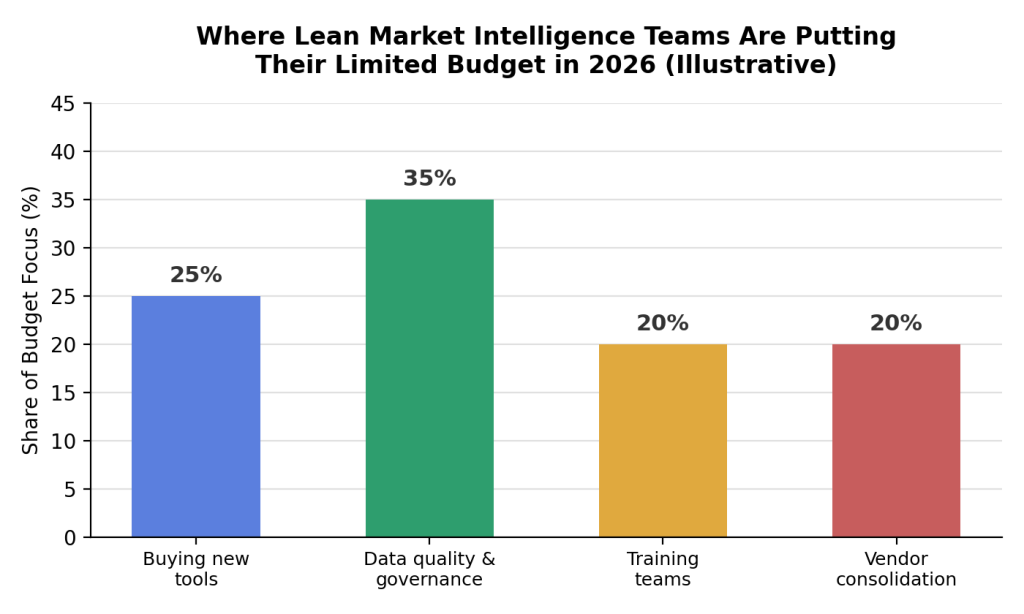
Notice that the largest piece is not allocated for new tools. It’s all about data quality and governance, ensuring that the data a team already has is clean, accurate and trusted. It is a subtle, but significant change.
From Buy More Tools to Build a Better Process
The solution to a research problem for years was to purchase a new tool. This is no longer a tenable strategy in 2026. Rather, many teams are refocusing their efforts to “how do we create a process that keeps going, even if we don’t have the same size team or budget?” This transition is reflected in several tangible changes:
- Providing more users with the ability to retrieve their own reports, rather than just trained analysts (self-service intelligence)
- Eliminating redundant subscriptions and continuing to use fewer, more popular resources
- Investing real time and real money in cleaning and organizing data before the addition of new analytics on top of the data.
- Opting for more user-friendly and understandable tools than complex and costly AI systems that lack transparency and trust with leadership
It’s not flashy in any way. However, it’s a realistic option. And realistic is exactly what a tight budget calls for.
There is a simple checklist before you spend that you can use.
Consider a few straightforward questions if your team is determining where to invest market intelligence spending this year to avoid wasting money:
- Will this tool or report actually influence the decision that we’ve made, or is it “nice to know”?
- Is it something we already have that we do this, maybe partially?
- Are we dealing with clear data and, if so, is it sufficient for this investment to truly benefit us?
- Is it a well that our team can use, or will it be left unused after a couple of weeks?
These are valuable questions to ask before agreeing to a new contract, and will prevent tools from accumulating unused.
What does this mean for small businesses?
This pinch is felt even more by smaller businesses, who typically have smaller staff and budgets. Again, smaller-Scale:
Don’t go out and buy five tools for a small business. Use one or two when necessary, but not more.
In fact, even if you have a large data set in a spreadsheet, if you have clean and organized customer information, it can be a long way to fancy software.
Even industry reports and customer feedback can be used and are a great resource, and they’re free or low cost.
The Bigger Picture
While tight budgets are uncomfortable, they aren’t all bad news. They impose discipline where it might not have been observed in loose budgets. Teams are becoming better at asking better questions, eliminating the things that don’t work and concentrating on the basics that really make good decisions: clean data, clear priorities and tools that are used, not simply purchased.
Market intelligence 2026 isn’t just about the largest budget or the best AI tool. It’s all about purposefulness. The winners of this year are the teams that take intelligence as an ongoing discipline and don’t see it as a single purchase.