
Social Engineering Attacks: A Silent Threat to Businesses
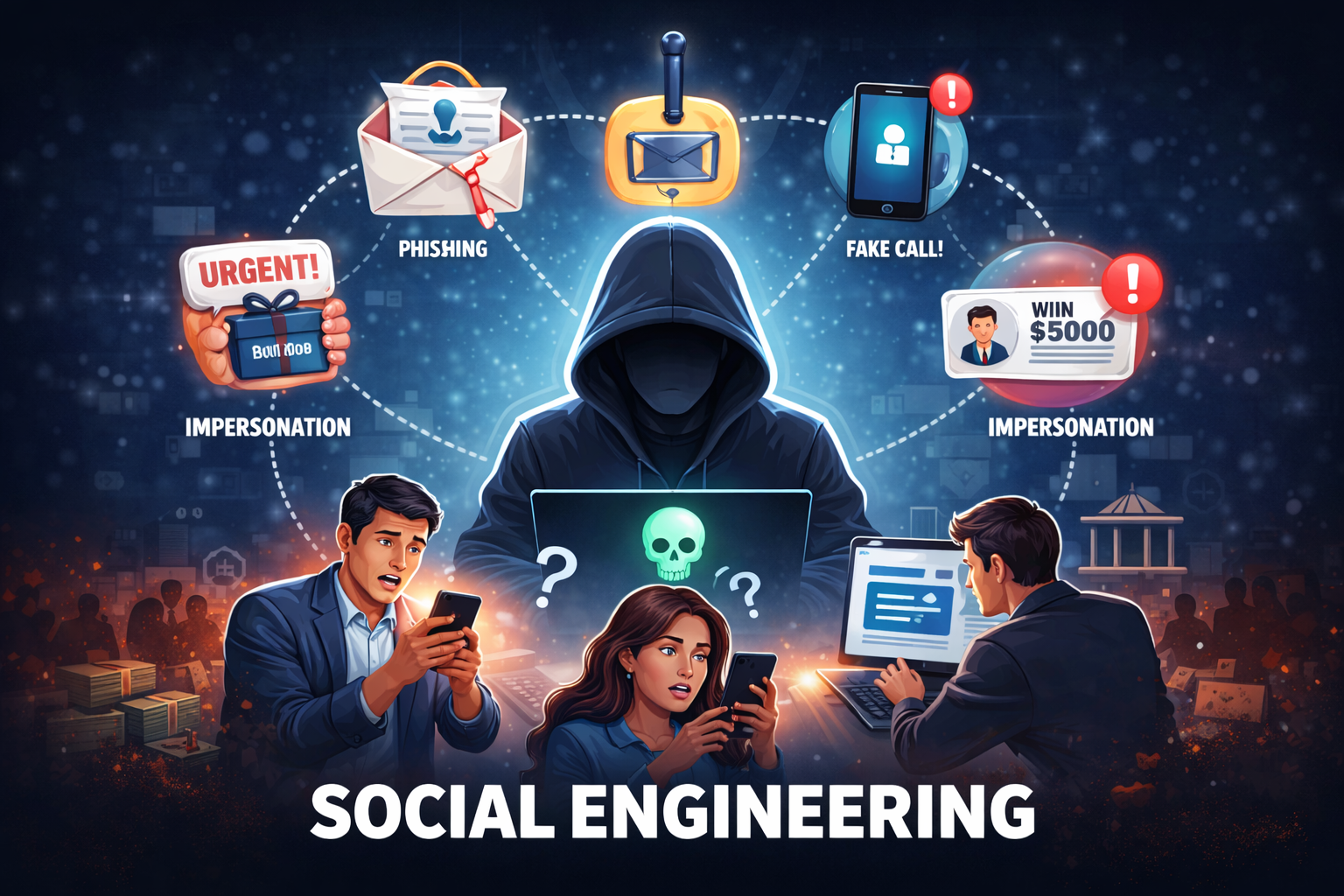
After the introduction of the cyberspace, people will think of viruses, ransomware or hackers that enter the system and introduce complex code. The social engineering attacks have been known to be even more menacing as far as malware continues to remain a threat in the current digital era. These attacks are not targeting the system but directly targeting people through control of trust, feelings and the ordinary daily life. This method of humanistic approach is more effective and difficult to monitor with the application of social engineering.
The Social Engineering Attacks: overview
The social engineering attacks can be seen as those which forcefully pressure the users to divulge confidential information or take some of the actions that can be useful to the attackers. Such attacks are limited to plain phishing messages or impersonation of a trusted organisation or fake calls, scam on WhatsApp or Telegram.
They are practical in the directness of their activities. The attackers do not need to be of high-technical expertise all that they need to do is to observe the actions of the human beings. They manipulate the victims into something that they do not consider by making them believe or look earnest or insistent because the demand is genuine.
Trend of Social Engineering Attacks in 2026
The social engineering attacks are increasing at a high rate all around the world. According to the recent cybersecurity reports, more than 85 percent of cyberattacks are associated with the human factor, and the most frequently used types of attacks are phishing and impersonation. It is projected that legal social engineering assaults will expand over 30 percent annually in 2026 due to rising digital communications, remote employment, and social networking.
This is especially risky to businesses, which are more likely to be targeted by attackers not at the system level but at the employee one. Researchers show that one out of three workers has actually encountered a suspicious message at least once and almost 60 percent of successful breaches and intrusions start with a social engineering technique. These statistics speak volumes of the fact that intruders are more likely to exploit human trust than technical ones.
The Rationality of human beings the weakest connection
Even safer systems are human interacted based on some of them. Individuals may be stressed or distracted or tired particularly within a work situations of high activity and during stressful situation. Social engineering makes use of such cases to instill fear, urgency or authority in people.
The few instances that can trigger a panic are as follows: a message stating that it has been issued by a bank that needs some urgency checkups. On the other hand, users are not rational but tend to be emotional. Human behavior is not a software and therefore, it cannot be resolved like software hence, this has been a great challenge in security.
The Socially of Security Systems Violation of Social Engineering
A majority of the cybersecurity equipment is established according to the malicious software detection rather than the malicious communication. The social engineering messages can be considered as completely valid and this allows passing through firewalls, spam filters and antivirus programs without ever giving a second thought.
This system will presuppose that the activity is approved as the victims will either supply the information freely or will not stop a person to supply information. Technically, there is no cause to be suspicious of a thing but a breach is occurring. This enables hackers to bypass a number of security levels in an invisible fashion.
The attackers can have accessed sensitive data or internal systems by the time the anomalous activity has been identified. This delayed detection is what increases the overall impact of the attack, and the reason as to why recovery would be more difficult.
Why Businesses Must Act Now
Social engineering attacks have a high financial implication. Organizations that are victims of social engineering breaches incur losses to the tune of $150,000 to a matter of millions of dollars on average depending on the size of the attack. Companies lose reputation, face legal repercussions, and lose customer confidence besides losing money.
The financial investment in security awareness training has paid off. Companies which train employees on a regular basis lower the probability of social engineering to as much as 60 percent. These statistics show that it is much more economical to prevent attacks with the help of education in comparison to pulling oneself out of it.
The Suggestion in the Real Life about individuals and organizations
The social engineering attacks can be radical success. The victims can lose money, personal information or access to valuable accounts. The outcomes are identity thefts and financial frauds.
It is devastating more when it comes to organizations. The fact that one of them fell into a hoax can be used to reveal sensitive data, disrupt the business processes and destroy the reputation of the company. Such incidences are usually time consuming and resourceful to recover.
How the Awareness and Training can reduce the Risk
Following the information about common forms of attack, any user will be better placed to be suspicious of doubtful messages and requests and verify them out first.
Organizations should undertake regular security awareness training and encourage the employees to report to the organization, in case of anything suspicious. Some of the simple steps including revisiting links, seeking to ascertain the identity of people sending emails, and not rushing to make decisions are likely to ensure that the risk is reduced significantly.
The human awareness integrated with technical security would offer a formidable front against social engineering attacks and will help defend people and systems.
Conclusion
The reality that social engineering attacks are not technological is threatening since they are trust-based. Malware attack affects the system and social engineering attack affects the judgment of the humans making it harder to prevent and succeed. Such attacks will continue to grow as long as the digital communication continues growing.
Social engineering is not about software and it is not about security software but it is about well informed suspicious users. By always being on alert and thinking and verifying their choices, people and organizations can dramatically reduce their risk and stay safe in the increasingly connected digital world.