
Beyond the Monolith: Why Micro Frontends are the Future of Enterprise Web Apps
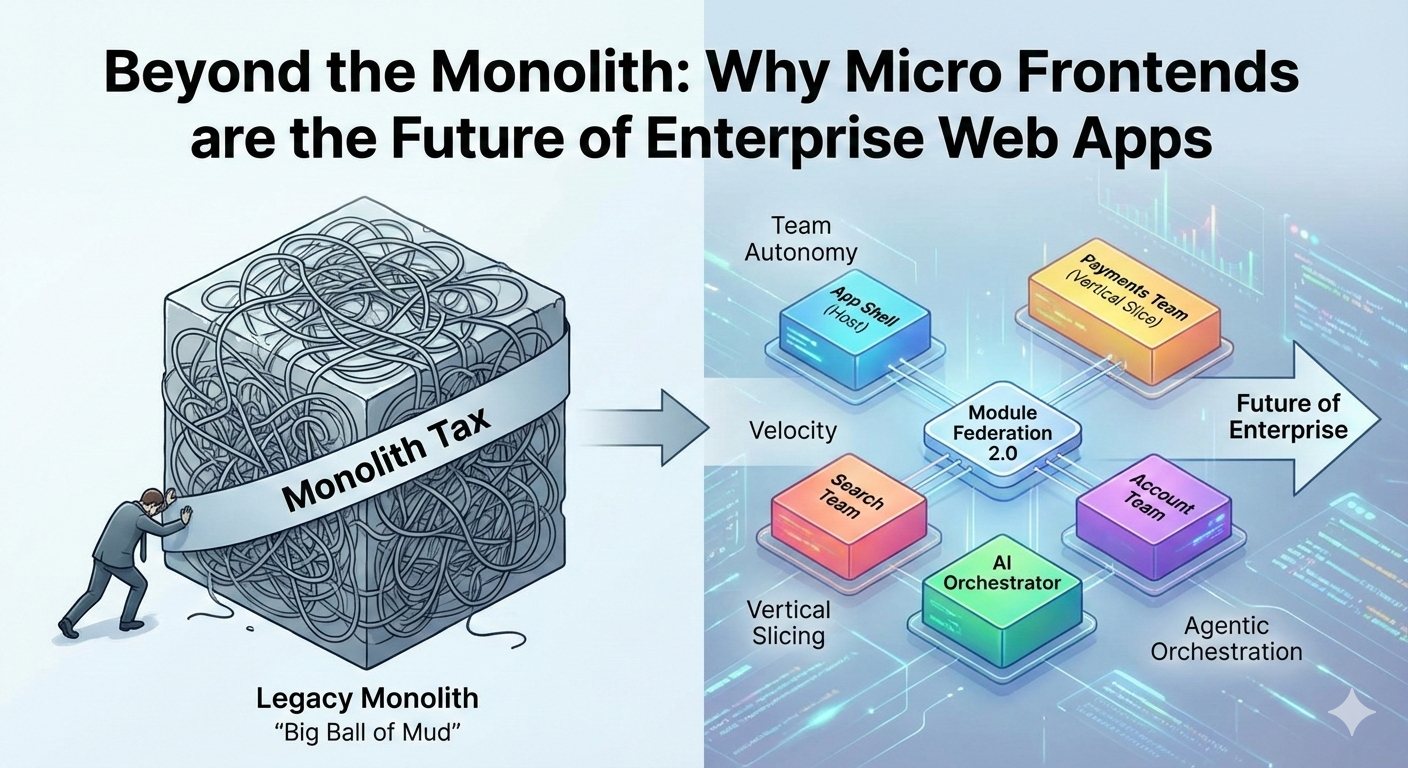
For years, the software industry had a dirty secret: while our backends were becoming sleek, modular microservices, our frontends were growing into bloated, brittle monoliths. We called them “The Big Ball of Mud.” One innocent CSS change in the footer would somehow break the login modal, and a simple framework upgrade would require a month-long “war room” session involving dozens of developers.
As we move through 2025, the tide has officially turned. Micro Frontends (MFE) are no longer an experimental “maybe” – they are the architectural standard for any organization that values velocity, autonomy, and long-term sanity.
1. The “Monolith Tax” and Why It’s Bankrupting Teams
In a traditional monolithic frontend, everything is tightly coupled. If your Payments team wants to deploy a hotfix, they have to wait for the Marketing team to finish their massive homepage redesign because everything sits in the same build pipeline. This is the “Monolith Tax.”
As applications grow, the cost of change increases exponentially. Real-world data shows that enterprise teams using monolithic architectures spend nearly 40% of their time dealing with “deployment friction” merge conflicts, environment instability, and coordinated release cycles. Micro Frontends aim to kill that tax by allowing teams to own their features from end-to-end.
2. Slicing the Pizza: Vertical vs. Horizontal Architecture
The biggest mistake teams made in the early days of MFEs was “Horizontal Slicing” where one team owned the header, another the footer, and another the main content. This led to endless layout shifts, communication overhead, and “zombie” components.
In 2026, the industry has converged on Vertical Slicing.
- The Domain-Driven Approach: You divide the app by business function. One team owns the “Cart” from the database and API all the way to the UI components.
- Team Autonomy: The “Cart Team” chooses their framework (React, Vue, or Svelte), they manage their own state, and they deploy to production 10 times a day without asking for permission.
- The App Shell: A lightweight, agnostic “container” that handles routing, global authentication, and loading states. It doesn’t care how the checkout works; it just knows where to find it.
3. The Technology Landscape: Module Federation 2.0
The real reason MFEs are finally “ready” for the mainstream is the stabilization of Module Federation 2.0. In the past, sharing code between apps meant messy <iframe> hacks or complicated NPM packages that had to be re-versioned every time a change was made.
Module Federation allows a “Host” application to dynamically load a “Remote” application at runtime. It feels like magic: the browser fetches only the code it needs for the specific page the user is on. Modern 2.0 features include:
- Type-Safe Contracts: Developers get full TypeScript support across different repositories as if they were in the same project.
- Dynamic Remotes: The shell can decide which version of a micro-app to load based on the user’s location, language, or A/B testing group.
- Native Federation: A shift away from being locked into Webpack, leveraging Import Maps and native browser capabilities for even faster performance.
4. Communication Without Coupling
One of the hardest parts of Micro Frontends is getting independent apps to “talk” to each other without becoming a tangled mess. How does the “Header” know there are three items in the “Cart” if they are different apps?
In 2026, we avoid “Global State” as much as possible. Instead, we use:
- The Browser Event Bus: Leveraging native CustomEvent APIs to broadcast messages (e.g., dispatch(‘cart-updated’)).
- Lightweight Shared Stores: Using tools like Jotai or Zustand as a thin communication layer that doesn’t force a full re-render of the entire page.
- URL as the Source of Truth: Passing state through query parameters ensures that users can still share links and use the “Back” button a common failure point in poorly designed MFEs.
5. The AI Twist: Agentic Orchestration
What makes the current landscape truly different is how AI Agents interact with these architectures. Because MFEs are modular and “discoverable,” they are the perfect playground for AI.
We are now seeing Agentic Orchestrators that sit in the App Shell. Instead of hardcoded routes, the agent analyzes the user’s intent. If a user says, “I need to dispute a transaction,” the orchestrator doesn’t just navigate to a page; it dynamically stitches together the “Transaction History” MFE and a “Support Case” MFE into a custom UI tailored to that specific problem.
Data shows that AI-powered MFE orchestration can lead to a 30% improvement in Time to Interactive (TTI) because the agent only loads the specific “micro-tools” required for the user’s immediate goal.
6. The “Tax” You Must Pay: Governance and Security
Micro Frontends aren’t a “free lunch.” They introduce complexity that must be managed:
- Bundle Bloat: If five teams each bring their own version of React, the user’s performance suffers. Solution: Use “Shared Singletons” in your federation config to ensure the browser only downloads the library once.
- CSS Isolation: You must ensure Team A’s styles don’t bleed into Team B’s layout. Solution: Use Tailwind CSS or Shadow DOM to keep styles isolated.
- Zero-Trust Security: Since you are loading code from different sources, you must implement Content Security Policy (CSP) and verify the integrity of your remote modules.
7. Migration Strategy: The Strangler Fig Pattern
Don’t attempt a “Big Bang” rewrite. The most successful MFE migrations use the Strangler Fig Pattern:
- Identify a low-risk feature in your monolith (like the “Settings” or “FAQ” page).
- Build that feature as a new, independent Micro Frontend.
- Use the App Shell to route users to the new MFE while keeping the rest of the monolith intact.
- Slowly “strangle” the monolith by migrating more features until it can be decommissioned.
Conclusion: Scalability is an Organizational Choice
Micro Frontends represent a shift from “building a page” to “orchestrating an ecosystem.” It requires more upfront architectural thought, but the payoff is a system that is resilient, scalable, and most importantly a joy to work on for developers.
As we look toward 2026, the question is no longer “Should we use Micro Frontends?” but rather “How quickly can we move away from our monolith to keep up with the competition?”