
End to End encryption and how it works
People exchange a tremendous amount of information online everyday in the digital day and age. We use personal applications to send information, video calls, transfer files and send personal messages. All of these activities would make life easier, but raise issues of privacy and security. This is where End-to-End Encryption (E2EE) comes into the picture.
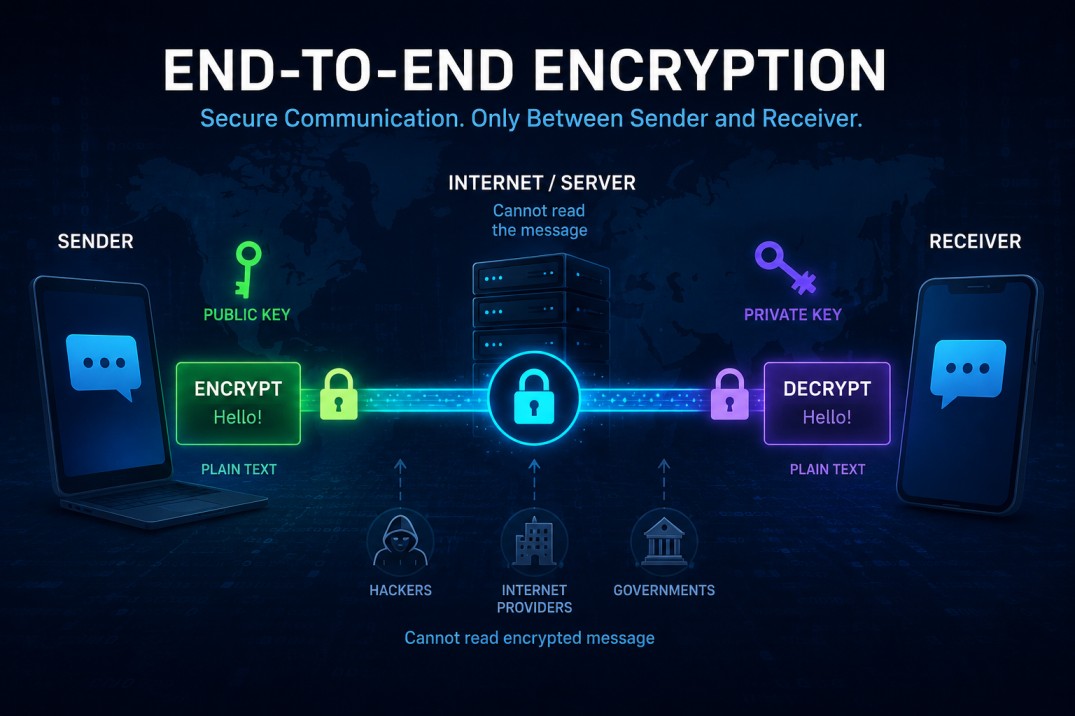
End-to-End Encryption is a method of security which means that the information that is being sent can only be read by the sender and the recipient. The content of the communication is not accessible by anyone else, including by hackers, by providers of Internet services or by the provider of the messaging service itself.
Now try to imagine that you are sending a letter in a locked box. Only the right individual to the box can open it and only he can read the message. When the box is sent to another person, he/she will not be able to read the contents of the box.
The process starts with the sending of a message by a user. Messages are encrypted, or scrambled into unreadable format, prior to sending from the device of the sender. The encrypted message thereafter is transmitted through Internet networks and servers. These systems can help get the message across, but cannot learn or change the contents of the message. Once recipient’s device received, the message is decrypted and thus can be made readable by a special private key.
The privacy safeguard is one of the best aspects of End-to-End Encryption. Individuals using the system can talk to each other without fear of intruding into public conversations. It’s very critical when sharing sensitive data, such as sensitive passwords, financial data, personal photos or business information.
End-to-End Encryption has already been adopted by many popular applications for the protection of their users. The technology is employed to ensure secure communication on messaging platforms like WhatsApp, Signal and Apple’s iMessage. More and more organizations are taking similar security measures – and with increasing privacy worries online.
However, End-to-End Encryption is no application of magic. If a user’s equipment has malware, or the user’s encryption keys have been lost, it may be difficult to retrieve the data. Also, while the actual text of the messages may not be visible, some information about the messages may be visible, known as metadata, such as who was communicating with who, and when.
But, despite the challenges, one of the most effective means of protecting digital communications is through E2E encryption. With the advancement of threats on the network, the requirement of the strong security systems will grow even more.
To sum up, E2E Encryption is an essential component of ensuring privacy online and secure communication. This enables individuals to communicate with each other without fear of their information being accessed by unauthorized parties. In today’s increasingly digital world, End-to-End Encryption is becoming an essential tool in ensuring an online environment that is more secure and reliable for everyone.